
Care
When a pad stops sticking
Half the packs people give up on still have life in them, and half the ones they keep using are already done. Telling those apart takes a look and a fingertip.
Read the gel first
Hold the pad under a lamp and tilt it. Gel in good order looks wet and even across the whole face, and it takes a fingerprint that fades in a second or two. That pad is fine whatever it did last time.
Gel that has gone matte, or that shows dry patches with a different sheen from the rest, is at the end of its run. So is gel that stays dented where you pressed it. Neither of those comes back.
Edges lift long before the middle does
A pad usually fails from the rim inward. The corner curls, the curl catches on clothing, and the lifted part never lies down again. Caught early, the fix is one night pressed flat on the liner under something with a bit of weight.
What you cannot fix is a curl that has separated the gel from the cloth backing. Look at the very edge of a lifted corner: if you can see a pale line between the two layers, that pad is delaminating and the rest of it will follow.
It might be the wire, not the pad
Before deciding a pack is dead, swap the lead. A pin tail that has been pushed onto the same post two hundred times widens, and a widened socket makes contact only when the wire happens to sit at the right angle. A snap cup with a splayed rim does the same thing.
The tell is inconsistency. A worn pad fails the same way every time; a worn wire fails when you move and comes back when you sit still. If a fresh lead fixes it, the pads were never the problem.
- Matte, patchy or dented gel: finished.
- Curled corner, layers still joined: flatten it overnight.
- Pale line between gel and cloth: delaminated, replace.
- Comes and goes when you move: look at the lead wire.
Buying the replacement
Start from the connector rather than the old packet, since packaging changes and the connector does not. Pull the wire, check whether it ends in a post or a cup, and take that answer to the shelf.
If the old pads were the smallest squares, this is a reasonable moment to think about a bigger shape or a mixed pack, because a single order of two dozen small pads costs less per piece than replacing four at a time.
Packs this note is about
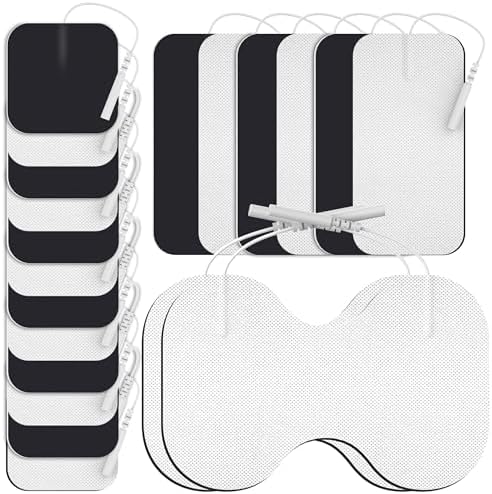
DOMAS TENS Unit Electrode Pads (XL)
TENS 7000 and other 2 mm pin units, DOMAS units
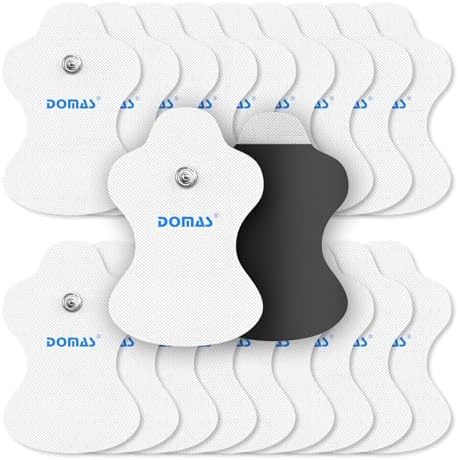
20 Pcs Replacement Pads Compatible with Omron TENS Units
Omron PM series
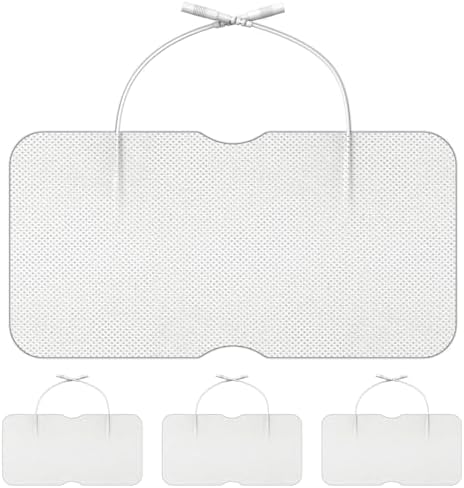
DOMAS Large TENS Pads for Lower-Back Pain Relief
TENS 7000 and other 2 mm pin units, DOMAS units
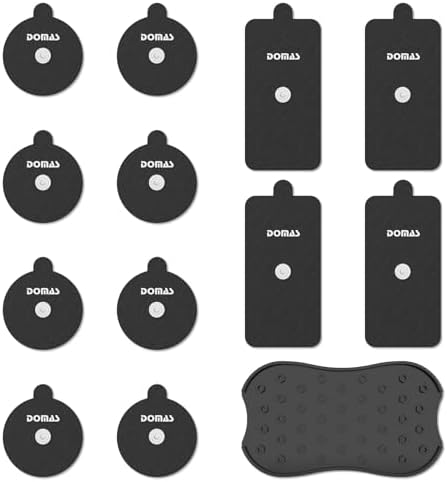
DOMAS TENS Electrode Pads
PowerDot 2.0
More from the bench
Pin or snap: which connector you have
Every pad on this site joins a wire in one of three ways, and they do not cross over. Two minutes with the wire in your hand settles which packs are yours.
Make a pack of pads last longer
Gel wears out in the drawer more often than it wears out in use. Four habits do almost all of the work.
Modes, timers and intensity steps
Three controls sit on the front of a unit like ours. What each one changes, in plain terms, and nothing about where anything goes.